
_edited.jpg)
Carved In Stone
Production Designer
Carved In Stone has been one of the biggest projects that SCAD has produced in the film department. This production is a combination of many student’s thesis projects including mine. I was brought to this project at an early stage, and I was privileged to be given the role of the Production Designer. They had already done a proof of concept, and the Director and the Producer had a specific vision for the overall project.

PRE PRODUCTION
Amelia Sloane, a gifted historian and photography student, who believes that the valuable artifacts of the world belong with their people, not locked up in a glass case in some museum. These beliefs put Amelia in direct confrontation with the academic community she calls home and only her beloved mentor, Dr. Douglass Bishop, sees the value in Amelia’s perspective.
After the tragic death of Doctor Bishop on an expedition-gone-wrong, Amelia is shocked to learn that she has inherited his collection of rare and valuable artifacts, including the legendary sword Excalibur. Bishop tasks Amelia with returning the sword to the stone from which it came. But when Amelia entrusts the sword to the wrong hands, it becomes a race with the fate of the world at stake.
Working on pre-production for a project is an exciting and crucial phase in the development of a film, TV show, or any creative endeavor. It involves laying the groundwork and setting the artistic direction for the project before actual production begins. In this case, we started pre-production during the summer of 2022. This was the first time for me to take a role like this for a project of this size.
During this stage, artists were brought onto the project to work on concept art and visual development. Concept art is a crucial component that helps visualize ideas, characters, environments, and key scenes, giving a tangible form to the creative vision. Visual development involves exploring various artistic styles, color palettes, and aesthetics to determine the overall look and feel of the project.
As a Production Designer, the role is to act as a bridge between the art department, the director, and the producer. I ensured that the artistic vision and direction set by the director were effectively communicated to the artists and that their work aligned with the overall goals and requirements of the project. Additionally, we collaborated closely with the producer to ensure that the artistic elements were in line with the project's budget and schedule.
Taking on the role of a Production Designer for a project of significant size can be a great opportunity for professional growth and a chance to showcase leadership skills. Being a good leader in this context means not only having a strong artistic vision but also being able to effectively communicate and collaborate with a diverse team of artists, technicians, and other professionals involved in the project. As a leader, I had to provide guidance, feedback, and direction to the artists while fostering a creative and collaborative environment. I also had to make decisions regarding artistic choices, problem-solving, and resource allocation to ensure the project's success.
We had a great amount of concept art created during pre-production and we explored a lot of different styles that allowed us to narrow things down and make choices that were pointing towards the overall vision for this production.
Gaining a comprehensive understanding of the locations required for our project presented us with a valuable opportunity to strategically select the ones that would benefit from utilizing the LED Volume stage. This allowed us to decide whether to search for existing locations or create them entirely from scratch, enabling us to optimize the advantages offered by the LED Volume technology.
We had around 17 different locations. Some of them were simple and easy to find already existing locations to shoot on, and others were more complex and required us to make a plan to take it to the stage. I will be presenting the process for the making of the three main locations created on the LED Volume during production.
Case study
The Enchanted Lake / Island

This particular setting exists in two distinct versions. Initially, it portrays a desolate island with minimal vegetation, encompassed by grand and whimsical ruins or rocks. However, a remarkable transformation occurs when a sword is inserted into a stone, turning it into a flourishing and vibrant environment. Even though this location was meant to be magical and not from our everyday world, we needed it to look realistic with a nature-inspired appearance. We had to think about the way things would change and the assembly process for each part of the set. One of the first things we did was to decide how much VFX we would
be using and how this would be executed. Our objective was to minimize reliance on
post-production techniques as much as possible.
After having the concept art approved, my first approach to the making of this set was to create a physical scale model that would help the Director and the Producer understand scale and proportions. This would also help the DP to get an idea of the blocking, the cinematography and understand how much space we would be having for gears and equipment on the stage.
Concept art by Nala J. Wu.


Concept art by Nala J. Wu.

Concept art by Nala J. Wu.


Concept art by Ellen Kenneda.

Concept art by Ellen Kenneda.

Concept art by Nala J. Wu.
Since these rocks had to look realistic and organic, my first approach was to sculpt them by hand to get closer to the look we were looking for. With the help of 3D printing and laser cutting, I was able to quickly get a scale model of the LED Volume stage where I could place the sculpted stones and analyze their placement.
SCALE MODEL
-27.jpg)
Scale model of the Enchanted Lake / Island.
After we aligned the style and scale of the stones, I created a lineup that represented each stone proportionally to communicate with the art department for the making process. Through this calculation, we were able to measure how much material we would be needing for each stone and the time that would take us to make them.

Lineup and paint elevation of the stones.
PRE VIS
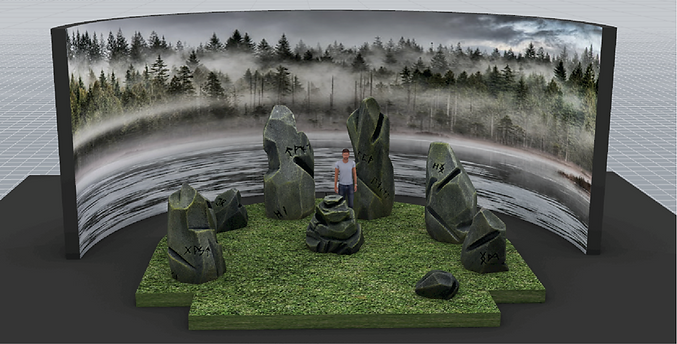
3D model of the Enchanted Lake / Island with 3D scans from the scale model’s stones.

3D model of the Enchanted Lake / Island with 3D scans from the scale model’s stones.
While working on getting the making of the set pieces started, I was simultaneously working with the Virtual Art Director to make sure we were both on the same page regarding the overall environment. This is a very collaborative process, and the virtual design team must be involved from the beginning to be able to achieve a cohesive product. Different versions of the background were created and modified during the pre-production stage.
VIRTUAL
ENVIRONMENT


Virtual environment of the Enchanted Lake / Island created in Unreal Engine by Yash Patel.


Virtual environment of the Enchanted Lake / Island created in Unreal Engine by Yash Patel.

MAKING
It took us about two weeks to have the nine stones carved and painted. We covered them in epoxy resin for durability and gave them a mossy look and some aging touches. One of the most challenging elements of this set was the ground. We thought about different ways to cover the stage to give it a natural look. We ended up getting fake grass and painting over it to break the consistency and make it realistic. In addition, we had to get a variety of plants and trees to bring the look we wanted. This was tricky because we knew there would be a transformation of the overall look on set.
PD and Art Department boards with final designs for the Enchanted Lake / Island.

The making of the set pieces with Styrofoam. Hand sculpted. Covered with resin epoxy. Painting of the stones.


Before and after on the making of the stones.

ASSEMBLY
The significantly big scale of the stones played an important role during the blocking on the stage. They helped to block the gap between the screen and the stage, making a continuous world. The vegetation on this set was also an important asset since it helped to fill out the space in between the stones.
After understanding the challenges during the assembly order for this set, we decided to start with the “dead” version of the island and then transform it into the “blooming” version during production. It was important to make a plan for the placement of the stones and be able to rotate them for camera purposes.
Platform and grass on the LED Volume stage.

Behind the scenes from Carved In Stone (The Enchanted Lake / Island) on the LED Volume stage.

Behind the scenes from Carved In Stone (The Enchanted Lake / Island) on the LED Volume stage.


Behind the scenes from Carved In Stone (The Enchanted Lake / Island) on the LED Volume stage.

Behind the scenes from Carved In Stone (The Enchanted Lake / Island) on the LED Volume stage.

Behind the scenes from Carved In Stone (The Enchanted Lake / Island) on the LED Volume stage.

Behind the scenes from Carved In Stone (The Enchanted Lake / Island) on the LED Volume stage.


Behind the scenes from Carved In Stone (The Enchanted Lake / Island) on the LED Volume stage.

Behind the scenes from Carved In Stone (The Enchanted Lake / Island) on the LED Volume stage.
PRODUCTION

Final result. Still frame from Carved In Stone (The Enchanted Lake / Island) on the LED Volume stage.

Final result. Still frame from Carved In Stone (The Enchanted Lake / Island) on the LED Volume stage.
_edited.jpg)
Final result. Still frame from Carved In Stone (The Enchanted Lake / Island) on the LED Volume stage.

Final result. Still frame from Carved In Stone (The Enchanted Lake / Island) on the LED Volume stage.
EXCAVATION
SITE

During the early stages of pre-production, discussions revolved around visiting a real-life setting for this particular scene. As the film's opening, we recognized the importance of making a grand impression and striving for utmost realism. Our initial point of reference was the ancient ruins of Rome, with their awe-inspiring grandeur. However, over time, our focus shifted to the captivating Lycian ruins located in Turkey, which ultimately became the chosen backdrop.

Research was a key step on the process to get the accurate look we were looking for. Given that our chosen location exists in our own world, it was crucial to accurately capture the style and essence of the original site. Working closely with both the physical and virtual art departments, I ensured that our creative direction aligned with our intended vision. I believe that the key to achieving a seamless outcome on the LED Volume lied in fostering a collaborative approach, treating both departments as a unified team.
RESEARCH
Research and mood board for The Turkey Excavation Site.
Research and mood board for The Turkey Excavation Site.
Recreating the Lycian ruins presented several challenges that demanded careful consideration and meticulous planning. Firstly, the Lycian ruins themselves possess a unique architectural style and distinctive characteristics that needed to be faithfully replicated. Capturing the intricacies and details of the ancient structures required a comprehensive understanding of their design, materials, and historical context. One of the primary obstacles was the sheer scale of the ruins. The Lycian ruins span a vast area, featuring grand structures, columns, and intricate carvings. Translating this to the LED Volume meant grappling with limited space and resources. The challenge lay in finding creative solutions to capture the essence and majesty of the ruins within the constraints of a controlled filming environment.


3D scan of the Lycian Ruins in Turkey.
Additionally, the weathered and aged appearance of the ruins added complexity to the recreation process. Achieving an authentic and believable portrayal necessitated careful craftsmanship and attention to detail. Each crack, weathered texture, and worn-out element had to be meticulously recreated to convey the passage of time and lend credibility to the set.
Collaboration between various departments was paramount to overcome these challenges. Close coordination between set designers, prop makers, visual effects artists, and cinematographers was crucial to ensuring a cohesive and realistic picture. The integration of practical set pieces with digital enhancements played a significant role in bridging the gap between the limitations of the movie set and the magnificence of the original ruins.
The virtual art department played a crucial role in setting the initial visual tone for the environment, providing invaluable guidance for the creation of the necessary set pieces. To achieve the desired level of realism, we were fortunate enough to acquire an actual 3D scan of the Lycian ruins. This scan served as a foundation, ensuring that our recreation captured the authenticity and intricate details of the original location.
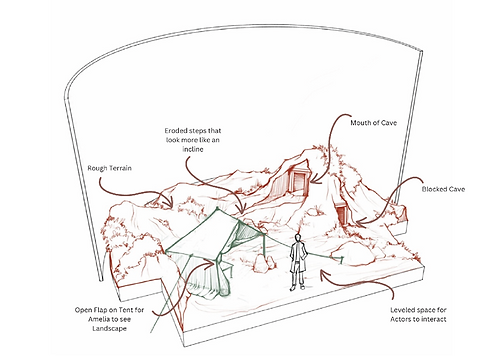
Preliminary drawings and concept designs for The Turkey Excavation Site by Ashutosh Rokade.
LAYOUT
During the creative process, the Director expressed a vision that included a camping tent as a key element within the scene. Taking this into account, we meticulously designed the physical set to accommodate and highlight the presence of the camping tent. This became a focal point, anchoring the action and adding a compelling dynamic to the overall composition of the set. By harmoniously blending the digital and physical aspects, we were able to seamlessly integrate the virtual representation of the Lycian ruins with the practical elements on the set. This cohesive approach ensured that the environment maintained a sense of continuity and believability, while effectively conveying the desired atmosphere and narrative intent.

Planning and blocking of set pieces for The Turkey Excavation Site on the LED Volume.

MAKING
We tried different ways of extending the ruins to the physical set. We thought about making the opening of the cave but we ended up changing the design since it was not necessary to have that physically made. Once the final design was approved and the blocking of each piece worked within the environment, we started working on making the set pieces with Styrofoam. At this point we had a better understanding on the carving process and it took us about a week to get all the pieces done. The challenging part was the paint job, it took a few tries to get the realistic look. We sprayed the base paint and then dry brushed the surface for textures. To achieve the weathered and aged appearance, we used a sponge with some deluded dark paint and this helped to make it more organic.
The making of the set pieces with Styrofoam. Hand sculpted. Covered with resin epoxy. Painting of the stones.


The making of the set pieces with Styrofoam. Hand sculpted. Covered with resin epoxy. Painting of the stones.


The making of the set pieces with Styrofoam. Hand sculpted. Covered with resin epoxy. Painting of the stones.
3D SCANNING
After getting the pieces ready, I 3D scanned each individual set piece and virtually brought them into the 3D model of the LED Volume. I wanted to get a full look of the blocking on the stage and share it with the Director, Producer and DP. Being able to see this prior setting up on the physical stage save a lot of time and it helps to make alterations beforehand to avoid modifications on set. I also wanted to add the 3D scans into the virtual environment for continuity. Even though we tried to match the aesthetics of the Lycian ruins, I believe that combining these pieces into the background would create a cohesive world and an authentic environment


3D scans of the set pieces for The Turkey Excavation Site made through Metascan.


3D model preview with 3D scans elements and colors on the LED Volume.

3D model preview with 3D scans elements and colors on the LED Volume.

3D model preview with 3D scans elements and colors on the LED Volume.
ASSEMBLY

Assembly of the platform on the LED Volume stage.

Behind the scenes from Carved In Stone (The Turkey Excavation Site) on the LED Volume stage.


Behind the scenes from Carved In Stone (The Turkey Excavation Site) on the LED Volume stage.


Behind the scenes from Carved In Stone (The Turkey Excavation Site) on the LED Volume stage.


Behind the scenes from Carved In Stone (The Turkey Excavation Site) on the LED Volume stage.


Behind the scenes from Carved In Stone (The Turkey Excavation Site) on the LED Volume stage.

Behind the scenes from Carved In Stone (The Turkey Excavation Site) on the LED Volume stage.

PRODUCTION

Behind the scenes from Carved In Stone (The Turkey Excavation Site) on the LED Volume stage.
COMING SOON
This project is currently in production!
Carved In Stone will be released in 2024. Stay tuned!
