.jpeg)
TIMECOP
Production Designer
For this project, I was working with students from the virtual production class. They were in charge of the virtual environment, and we were tasked to create a physical set to use in the LED Volume stage that blends with the digital background they created. In this case, I was presented with a visual reference of the overall vision of the project and with an advanced version of the final look for the digital environment.
A preview of the virtual environment was also given at the early stages. This makes the ideation process better for the production design team because it helps to get an understanding of how the world is going to look like. Once this information was presented, I started working on my research and finding the best way to illustrate what I had in mind. Since we were approaching geometric shapes, I decided to create a quick 3D model of the space to get a visual representation and the Director’s approval.
DESIGN
Research board (colors and textures)
Case study
_edited.png)
Still shot from the digital environment in Unreal Engine.

On this opportunity, I was tasked to create an architectural space. The director had a clear vision of the overall style for this scene, and I was provided with a section from the script which described the location for this set. We did not have a lot of time to create the set pieces and I knew I had to find a faster and efficient way to get the pieces done.

Drafting and 3D model of the Time Force Headquarters Balcony for TIMECOP.
Previewing the outcome through 3D software like this helps not only the production design department but also the director and everyone involved. With this technology, the team can pre-visualize shots and plan the scenes ahead. A key element to achieving a realistic and seamless blend of physical assets with the virtual environment on the LED Volume stage is how the set pieces are distributed in the space or the “blocking.” The magic happens by strategically blocking the screen’s border with the set elements to create a cohesive and continuous world. Through virtual cameras, we are able to frame the shots on the 3D model and understand the cinematography during pre-production.
Since I needed to get the balustrades to all look the same for the railing of the balcony, I decided to create a 3D model of the balustrade itself and used the CNC machine to carve the Styrofoam and get a repetition of the same shape. In less than a day we were able to get all the foam carved and ready for the next step.
MAKING
Styrofoam carved by CNC machine.

The making of the set pieces with Styrofoam. Painting and dry brushing to create more texture.

.jpeg)
The making of the set pieces with Styrofoam. Machine carved.
TRANSPORTATION & SETUP

Building the set on the LED Volume stage.
.jpg)
Transportation of the set pieces.
Assembly timelaps.
.jpeg)
The set built at the LED Volume stage.
Once the set is built on the stage, the next step is to start testing the digital environment on the LED Volume. The advantage of having this technology during production is that corrections can be done on site. Since most film sets are created using 3D technology, the utilization of this optimization provides several advantages. It enables improved presentation protocols for directors and producers, and facilitates faster and more precise design reviews within the Art Department. Going a step further, game engines such as Unreal Engine (UE) and Unity offer the ability to create intricate virtual sets that appear as if they were captured by a camera in real time. By utilizing control monitors, directors and Directors of Photography (DP) can observe immediate set extensions. Additionally, recent advancements have allowed these sets to be displayed on large surround LED screen stages. These screens eliminate the need for extensive post-production and Visual Effects (VFX) work to adjust lighting and incorporate 3D elements. Furthermore, they enhance actor interactions and provide greater flexibility in camera movements.

SHOOTING


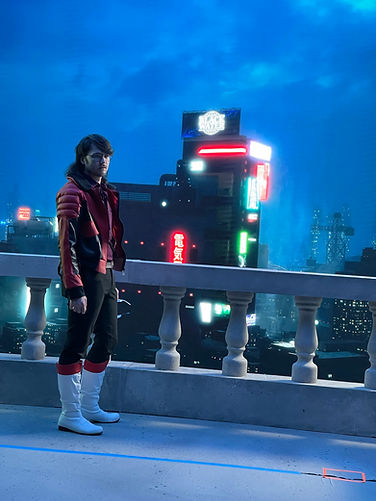
Behind the scenes from TIMECOP at the LED Volume stage.
.jpeg)
Behind the scenes from TIMECOP at the LED Volume stage.
COMING SOON
Proof of concept has been approved and it is currently in production! TIMECOP will be released in 2024. Stay tuned!